Tag: Borno

  • SERAP, NGE Urge Tinubu, Governors to Protect Journalists, Tackle Insecurity

    SERAP, NGE Urge Tinubu, Governors to Protect Journalists, Tackle Insecurity

    The Socio-Economic Rights and Accountability Project and the Nigerian Guild of Editors have called on the administration of Bola Tinubu, state governors, and the Minister of the Federal Capital Territory to urgently safeguard press freedom and address worsening insecurity across parts of northern Nigeria.

    The call was made in a joint statement to mark World Press Freedom Day, following a conference held in Ikeja, Lagos, where stakeholders discussed the role of the media in promoting accountability, justice, and human rights amid rising violence.

    Both organisations stressed that protecting journalists and ensuring information integrity are critical to peace, security, and democratic stability. They warned that continued attacks on media practitioners and restrictions on press freedom could further weaken governance and fuel misinformation.

    According to the groups, ongoing violence in states such as Benue, Borno, Kwara, Plateau, and Sokoto has led to widespread killings, displacement, and destruction of livelihoods, with women and children disproportionately affected.

    They described the situation as a reflection of systemic failures to prevent harm, investigate abuses, and hold perpetrators accountable, noting that such lapses violate Nigeria’s obligations under the Constitution and international human rights frameworks.

    The organisations also highlighted the humanitarian consequences of the crisis, including разрушed communities and lack of justice for victims, warning that persistent impunity continues to erode public trust in government institutions.

    Referencing the 2026 global theme by UNESCO, “Shaping a Future of Peace,” they emphasised the central role of a free and independent media in fostering stability and sustainable development.

    They noted that Sections 22 and 39 of the Nigerian Constitution mandate the media to hold government accountable and guarantee freedom of expression, urging authorities not only to refrain from interference but also to actively protect journalists.

    Among their recommendations, SERAP and NGE called for thorough and independent investigations into human rights violations, prosecution of offenders and their sponsors, and effective remedies for victims, including compensation and rehabilitation.

    They also urged the Federal Government to improve transparency in security operations, establish public reporting systems for tracking incidents and responses, and collaborate with international bodies for independent fact-finding missions.

    The groups further appealed to the National Assembly to exercise its oversight powers by convening public hearings on insecurity and attacks on journalists, with a view to strengthening legal protections and accountability mechanisms.

    Speaking at the event, human rights lawyer Femi Falana described impunity as a major driver of violence, warning that any government that fails to protect its citizens undermines its legitimacy.

    He emphasised that journalists play a vital role in exposing abuses, preventing violence, and strengthening democracy, adding that they should be seen as partners rather than adversaries.

    The event brought together media executives, editors, and civil society actors, all of whom expressed commitment to advancing press freedom and ensuring accountability in Nigeria’s governance and security systems.

  • Ndume Raises Alarm Over Keke Bomb Delivery by Terrorists

    Ndume Raises Alarm Over Keke Bomb Delivery by Terrorists

    Borno South Senator, Ali Ndume, has raised fresh alarm over the evolving tactics of terrorists and bandits in Nigeria, warning that their operations are becoming increasingly organized and dangerous. Speaking on Channels TV’s Politics Today, Ndume highlighted the growing sophistication of criminal networks and their reliance on local informants.

    The lawmaker explained that insurgents now employ “hit-and-run” tactics, coordinating attacks within communities and often gathering intelligence from unsuspecting citizens. He warned that these methods make it difficult for security agencies to anticipate or prevent strikes.

    Ndume revealed that terrorists have begun using commercial tricycles, known as Keke Napep, to transport explosives to targeted locations. “You can imagine, even the bomb that exploded, it was delivered by Keke Napep. They package it and give it to people in Keke Napep to deliver at specific spots,” he said, stressing the adaptability of insurgent strategies.

    The senator blamed the worsening security situation on weak intelligence networks, urging authorities to strengthen surveillance and improve information gathering to counter these threats effectively. He also noted the increasing boldness of insurgents, some of whom record and share their attacks on social media platforms such as TikTok.

    Ndume emphasized that understanding the operational patterns of these groups is critical, as they continuously seek ways to infiltrate communities, execute attacks, and escape, highlighting the urgent need for enhanced community awareness and proactive security measures.

  • Maiduguri Bomb Blasts Kill Dozens, Injure Over 100 as Nigeria Faces Renewed Terror Threat

    Maiduguri Bomb Blasts Kill Dozens, Injure Over 100 as Nigeria Faces Renewed Terror Threat

    Maiduguri, the capital of Borno State, was thrown into chaos on Monday night following a series of deadly bomb blasts that survivors say felt like a war zone. The explosions, which occurred at crowded locations including the Monday Market, Post Office flyover, and the entrance of the University of Maiduguri Teaching Hospital (UMTH), left scores dead and many others injured. Witnesses described scenes of panic, confusion, and devastation as people fled in different directions to escape the blasts.

    Official figures released by the police indicate that at least 23 people were killed and 108 others sustained varying degrees of injuries. However, hospital sources and eyewitnesses suggest the death toll could be significantly higher, with some estimates exceeding 40 fatalities. Medical personnel at UMTH confirmed that dozens of injured victims are still receiving treatment, many of them in critical condition, while urgent calls for blood donations have been made to save lives.

    Survivors recounted harrowing experiences from the attacks. One victim described how he had just finished the day’s business and was preparing to leave the market when a loud explosion threw the area into disarray. Another survivor said the blast temporarily deafened him, leaving him disoriented as smoke filled the air and injured victims lay scattered on the ground. Families have also reported missing relatives, adding to the anguish in the aftermath of the tragedy.

    Security agencies have attributed the attacks to suspected suicide bombers linked to Boko Haram, warning that more attackers may still be at large. According to military sources, the explosions were part of a coordinated effort to target densely populated civilian areas and inflict maximum casualties. In response, joint security teams comprising the military, police, and explosive ordnance units have been deployed across Maiduguri to secure affected locations and prevent further attacks.

    Reacting to the incident, President Bola Tinubu condemned the attacks and directed service chiefs to relocate to Maiduguri to oversee security operations. He assured citizens that the government would intensify efforts to combat terrorism and restore normalcy, emphasizing that such acts of violence would not be allowed to destabilize the country.

    Political leaders and stakeholders across the country have also expressed concern over the renewed wave of violence. Former Vice President Atiku Abubakar warned that the resurgence of terrorist attacks could undermine public confidence in the government’s ability to ensure safety. Similarly, Senator Ali Ndume and northern governors called for urgent and decisive action to address the deteriorating security situation.

    The African Democratic Congress (ADC) also condemned the attacks but criticized the federal government’s handling of the situation, questioning the timing of the president’s trip abroad during a national crisis. The party stressed that protecting lives and property must remain the government’s top priority.

    As investigations continue, residents of Maiduguri remain on edge, grappling with the aftermath of the હુમલાઓ and the fear of further violence. The incident has reignited concerns about the persistence of insurgency in the North-East and the urgent need for more effective security strategies to safeguard civilians

  • Nigerian troops kill three Boko Haram militants

    Nigerian troops kill three Boko Haram militants

    Nigeria Troops

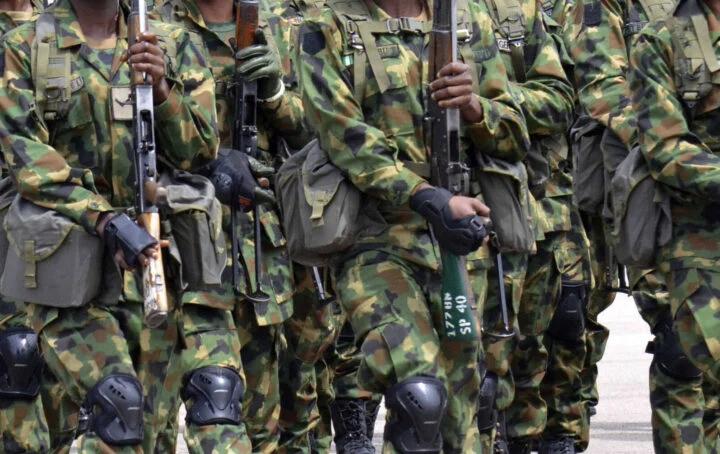
    Troops of the Nigerian Army, under Operation Hadin Kai, have killed three Boko Haram militants in an ambush in Umbo Gen, Borno State.

    The incident occurred on Monday evening during Operation Desert Sanity IV, according to security analyst Zagazola Makama.

    The operation, conducted alongside members of the Civilian Joint Task Force (CJTF) and local hunters, involved a heavy exchange of fire that forced the insurgents to retreat.

    A source confirmed that three terrorists were neutralized and that troops recovered an AK-47 rifle and an Itel mobile phone.

    No casualties were reported among the soldiers, though security in the area remains calm but unpredictable.

  • Suspected IED blast kills two children in Borno

    Suspected IED blast kills two children in Borno

    Tragedy struck in Konduga, Borno State, when an Improvised Explosive Device (IED), mistaken for scrap metal, exploded and reportedly killed two children while injuring four others. The victims had picked the device from an excavation site where a government project is ongoing and unknowingly struck it against a tarred road, triggering the blast.

    Residents confirmed that six boys had carried the device into town, with two later succumbing to severe injuries. The other four are receiving treatment at a hospital in Maiduguri.

    However, a military source disputed the reported deaths, insisting that the explosive was a hand grenade likely left behind by insurgents, and that only four children sustained injuries with no fatalities recorded.

  • Three boys drown in pond behind Monguno hospital

    Three boys drown in pond behind Monguno hospital

    Security analyst Zagazola Makama confirmed the incident in a post on X on Friday, identifying the victims as Mallam Gana Mohammed, Modu Audu Saleh, and Abba Ngumami, all residents of the Water Board IDP Camp in Monguno.

    According to Muhammed Aisami, father of one of the boys, they went swimming around 7:40 a.m. on Thursday when the tragedy occurred. Emergency workers and police, assisted by local residents, recovered the bodies, which were later confirmed dead by medical staff at the hospital. Authorities reported no signs of violence.

    The remains have been released to the families for burial in accordance with Islamic rites.