


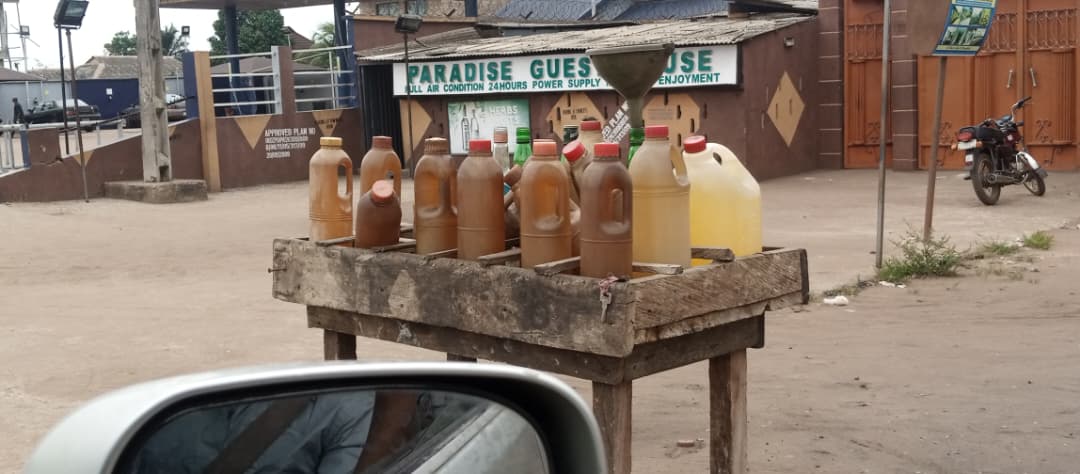
 Six years and two months after the administration of Muhammadu Buhari banned the sale of petroleum products to filling stations within 20 kilometres of Nigeria’s land borders, residents of affected communities say the policy continues to inflict economic hardship despite partial waivers.
The restriction, announced in November 2019, was aimed at curbing the smuggling of subsidised fuel to neighbouring countries and cutting off supply routes to bandits and terrorist groups operating around border areas. In March 2020, the Federal Government approved waivers for 66 filling stations across border states, a decision coordinated by the Nigeria Customs Service and the Office of the National Security Adviser to ease the suffering of residents forced to travel long distances for fuel.
In Ogun State, particularly in Ipokia, Imeko Afon, Yewa North and Yewa South local government areas, residents say the relief has been limited. Community leaders recount that during the 2024 fuel crisis, petrol sold for as high as N2,000 per litre on the black market, while transport fares tripled. Ahmed Ismaila, Chairman of the Community Development Association in Iwoye-Ketu, said residents sometimes paid N3,000 for trips that previously cost between N700 and N800.
Black marketers reportedly source petrol from towns such as Owode and Ota before reselling in border communities like Idiroko and Ijofin at inflated prices. Although residents now buy fuel at between N800 and N900 per litre at licensed stations following recent waivers, scarcity persists whenever supplies run out, pushing black-market prices to about N1,200 per litre.
In May 2025, the Federal Government granted additional waivers to five filling stations in Ogun State after sustained lobbying by the lawmaker representing Yewa North/Imeko-Afon Federal Constituency, Gboyega Nasir Isiaka. He described the move as a step toward “economic justice,” but acknowledged it was only the beginning of broader efforts to address residents’ concerns. Findings indicate that more than 160 filling stations in the state still fall within the restricted border zones.
Residents in communities without waivers say they continue to endure long journeys and high transport costs to obtain fuel. Abdulganiyu Babatunde, a resident of Ijofin, alleged that some licensed stations operate selectively, leading to queues and overnight waits. He added that commuters from areas such as Idi-Oke can spend up to N5,000 on transportation to purchase petrol, with motorcycle fares rising from N100–N200 to about N500.
Traditional rulers have also joined calls for a full review of the policy. The Eselu of Eselu Kingdom, Oba Akintunde Akinyemi, urged President Bola Tinubu to lift the ban, questioning its relevance following the removal of fuel subsidy. He argued that while smuggling concerns were valid during the subsidy regime, the justification appears weaker under deregulated pricing.
Despite the restrictions, smuggling has persisted. The Nigeria Customs Service in Ogun State reported seizing more than 190,000 litres of petrol in the past year. In May 2025, Comptroller-General Bashir Adeniyi disclosed that Operation Whirlwind intercepted 39,425 litres of petrol valued at N39.4 million along the Lagos-Ogun axis, with additional seizures recorded in subsequent months at known smuggling flashpoints.
Human rights advocates have criticised the continued enforcement of the ban. The National President of the Committee for the Defence of Human Rights, Yinka Folarin, argued that restricting access to fuel undermines residents’ socio-economic rights, particularly in communities with limited electricity supply. Citing constitutional provisions and the African Charter on Human and Peoples’ Rights, he called for enhanced border security rather than blanket restrictions.
While the Federal Government maintains that the policy targets illicit fuel diversion, affected communities insist that a comprehensive lifting of the ban is overdue, saying it would restore business activities, reduce transport costs and ease mounting socio-economic pressures in Nigeria’s border regions.


