


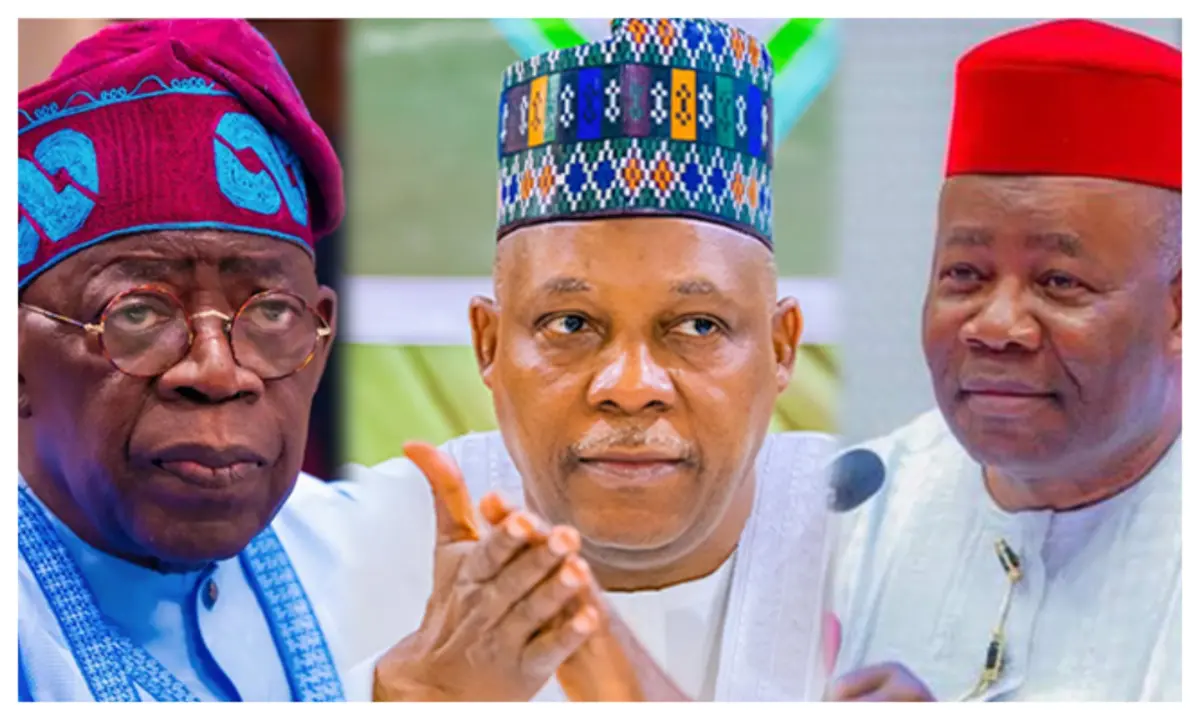
 The Federal Government is considering a review of salaries for political office holders, sparking sharp criticism from academics, economists, and civil society groups who argue that such a move reflects misplaced priorities at a time of widespread poverty and economic hardship.
Chairman of the Revenue Mobilisation Allocation and Fiscal Commission (RMAFC), Mohammed Shehu, disclosed the proposal at a press briefing in Abuja on Monday.
Shehu noted that the salaries of top government officials had not been adjusted since 2008. He revealed that President Bola Tinubu currently earns ₦1.5 million monthly, while ministers earn less than ₦1 million — figures he described as “a joke” for leaders of a nation of over 200 million people.
He also highlighted the disparity between political office holders and heads of federal agencies, some of whom reportedly earn as much as 20 times more than cabinet ministers or even the Attorney-General of the Federation.
But the announcement has been met with backlash in a country where millions are battling inflation, weak purchasing power, and a cost-of-living crisis. The minimum wage, recently raised to ₦70,000, has yet to be implemented by many states, particularly for local government workers and teachers.
According to the National Bureau of Statistics, 133 million Nigerians — 63 percent of the population — are multidimensionally poor, with poverty particularly severe in rural areas.
Critics Fault Priorities
Professor Chidiebere Nwachukwu of the University of Nigeria described the proposed salary hike as an insult to ordinary citizens.
“It is as if Nigeria exists only to cater to greedy politicians while the people who do the bulk of the work are ignored,” he said. “Civil servants go to the same markets as politicians, yet they are paid peanuts.”
Nwachukwu warned that neglecting workers while rewarding politicians risked fueling unrest. “The people that need an increase are the teachers, the nurses, the policemen. If this continues, we risk a revolt against the ruling class.”
He added that Nigerians had lost faith in government promises, accusing successive administrations of prioritising elections over governance.
‘Wrong Priorities,’ Says Economist
Economist Dr. Samson Simon of ARKK Economics and Data Limited also criticised the move, arguing that lawmakers and political leaders are already among the highest earners in the world when allowances and other benefits are factored in.
“For a federal lawmaker, the total take-home can reach ₦30 million monthly, or about $240,000 annually. That is more than many lawmakers in the world’s richest countries earn,” he said.
Simon described the proposal as “wrong priority,” stressing that workers on the frontlines — teachers, doctors, security personnel — deserve urgent wage adjustments, not politicians.
‘A Deception’ — Legal Expert
Legal analyst and President of the Civil Rights Realisation and Advancement Network (CRRAN), Olu Omotayo, dismissed the proposal as deceptive.
He argued that politicians already enjoy extensive perks and allowances that far outweigh their basic salaries.
“Public officials in Nigeria live almost entirely at government expense,” Omotayo said. “From travel allowances to official perks, the salaries are just a fraction of what they actually receive. The government should be cutting these excesses, not increasing political salaries.”
A Nation Divided on Cost of Governance
The proposal has reopened a familiar debate in Nigeria about the cost of governance, leadership accountability, and public trust.
Observers say the move could further alienate citizens at a time when economic pressures are pushing millions deeper into poverty.


