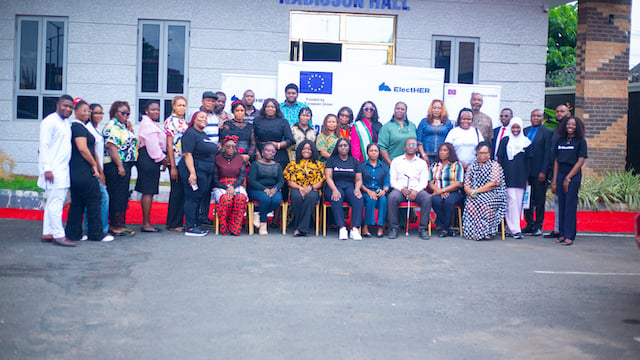
Awka, Anambra State — Pan-African non-partisan organization promoting gender-inclusive democracy, has concluded a two-day stakeholder engagement in Anambra State aimed at ensuring a secure, inclusive, and peaceful governorship election on November 8, 2025.
The engagement, held at Radisson Onyx Hotel, Awka, brought together representatives from the Independent National Electoral Commission (INEC), security agencies, political parties, civil society, academia, journalists, and grassroots leaders. Discussions focused on voter mobilization, women’s participation, and strategies for credible, inclusive polls. The initiative was supported by the European Union’s Support to Democratic Governance in Nigeria programme.
Ibijoke Faborode, CEO of ElectHER, highlighted Anambra’s legacy of women’s political participation, from Dame Virginia Etiaba’s tenure as Nigeria’s first female governor to consistently high numbers of female legislators. However, she noted a significant gap between voter registration and representation, revealing that women constitute 58% of new registrants but occupy only 0.6% of elected positions in the state. “We cannot allow insecurity and systemic exclusion to silence women in a state where they form such a significant share of the electorate,” Faborode said.
Zigwai Tagwai, ElectHER’s Democracy and Governance Programmes Lead, emphasized the importance of collaborative efforts by INEC, political parties, the media, and security agencies to restore trust and boost voter turnout. Stakeholders offered practical recommendations, including fact-checking by media outlets, electronic transmission of results to prevent delays, effective deployment of BVAS technology, and verification of information to counter misinformation.
Civil society groups stressed that insecurity, misinformation, and weak political party commitments remain major barriers to women’s participation. The dialogue resulted in concrete commitments: INEC pledged to expand ad hoc staff recruitment and improve polling unit management; civil society groups committed to voter mobilization and citizen hotlines; media representatives vowed to strengthen ethical reporting; and security agencies agreed to preventive deployments and gender-sensitive protection measures.
Political parties were urged to focus on issue-based campaigns addressing citizens’ concerns, including security, employment, and healthcare, while enhancing visibility for women candidates.
ElectHER concluded the engagement with a visit to the Nigeria Security and Civil Defence Corps, where State Commandant Maku Olatunde reaffirmed the Corps’ commitment to safeguarding the elections and stressed that female officers will be adequately deployed to ensure gender-sensitive election security.