


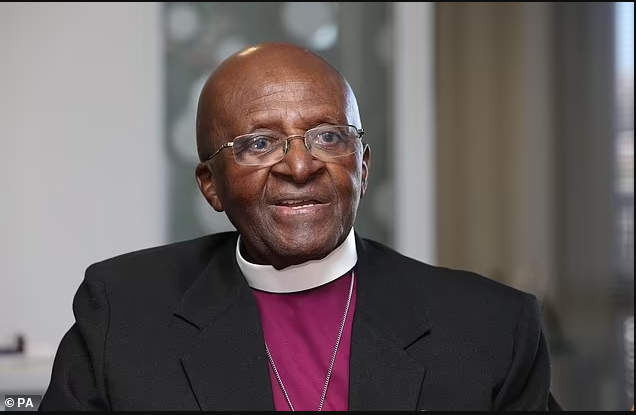
The body of late South African Archbishop Desmond Tutu will be aquamated.
The process is an alternative to cremation using water and chemicals, instead of fire. It’s considered to be more environmentally friendly.
He will be interred behind the pulpit at St George’s Cathedral, Cape Town, where he served as an Anglican Archbishop for 35 years.
The ‘environmentally friendly’ process involves heating the body in a mixture of potassium hydroxide and water for up to 90 minutes leaving only the bones. These are then rinsed in the solution at 120C (248F), dried, and pulverized into ashes.
The Dean of St George’s Cathedral, the Very Reverend Michael Weeder, confirmed that it was what Archbishop Tutu ‘aspired to as an eco-warrior’.
The Nobel Peace Prize laureate who helped end apartheid in South Africa died on Sunday, December 26. He was 90. Before his death, the anti-apartheid campaigner had insisted there should be ‘no ostentatiousness or lavish spending’ on the ceremony.
Tutu, who was South Africa’s first black archbishop, wanted ‘the cheapest available coffin’ with only ‘a bouquet of carnations from his family’, according to the Archbishop Tutu IP Trust and the Desmond and Leah Tutu Legacy Foundation.
Desmond Tutu’s body had been lying-in-state in the cathedral where he preached against racial injustice. His burial is expected to take place this weekend.
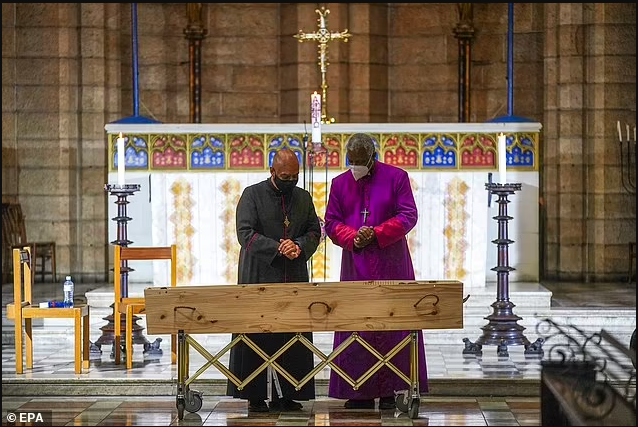
President Cyril Ramaphosa is expected to deliver the main eulogy at the service at St George’s Chapel in Cape Town.
Hundreds of mourners stood in long queues on Thursday and Friday, some singing, others carrying flowers and writing on tribute books in memory of the Nobel Peace Prize winner.


