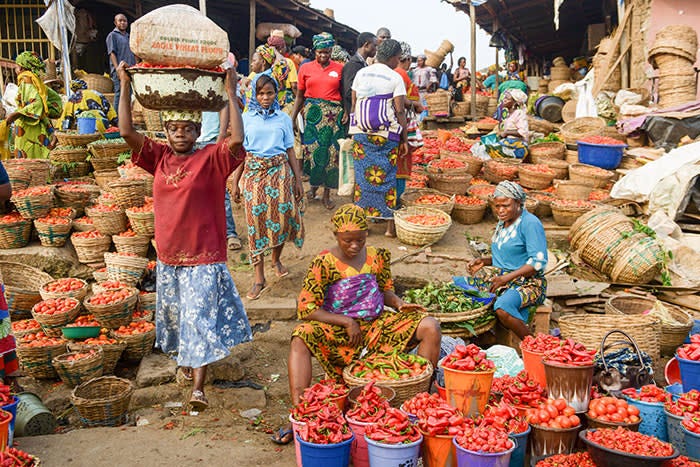
Nigerians are facing renewed cost-of-living pressures as food prices surged in February 2026, compounding the impact of rising fuel and energy costs across the country.
Latest data released by the National Bureau of Statistics (NBS) shows that food inflation rose sharply to 12.12 percent in February, up from 8.89 percent recorded in January. The increase was driven by higher prices of staple items such as beans, cassava, yam flour, millet flour, crayfish, and vegetables.
The development comes as President Bola Ahmed Tinubu begins an official visit to the United Kingdom at the invitation of King Charles III.
Despite the spike in food prices, headline inflation recorded a marginal decline to 15.06 percent in February from 15.10 percent in January. However, on a month-on-month basis, inflation accelerated to 2.01 percent, indicating a faster pace of price increases compared to the previous month.
Fuel prices also climbed significantly during the period, with petrol selling between ₦1,261 and ₦1,330 per litre nationwide, up from about ₦875–₦900 before the late-February escalation of tensions involving Iran, the United States, and Israel. The increase has pushed transportation costs higher, further straining household budgets.
The Dangote Refinery also raised its ex-depot petrol price to ₦1,175 per litre, triggering retail price hikes by major marketers, including MRS and Optima filling stations in Abuja.
Economic experts say the rise in food prices reflects a mix of seasonal trends and deeper structural challenges. Economist Ayo Teriba noted that food prices typically dip in January before rising in February as economic activities pick up after the holiday season. He cautioned, however, that it remains unclear whether the latest increase signals a sustained inflationary trend or short-term volatility.
Meanwhile, Professor Godwin Oyedokun of Lead City University said the slight drop in headline inflation offers little relief to households. According to him, the marginal 0.04 percentage point decline is largely statistical and does not translate into meaningful improvements in living conditions.
Oyedokun warned that rising food inflation is particularly concerning because it directly affects household welfare, especially among low- and middle-income earners. He attributed the trend to high energy costs, insecurity in farming regions, logistics challenges, and post-harvest losses.
He added that the current situation reflects cost-push inflation, where increased production and distribution costs are passed on to consumers. Without addressing these supply-side constraints, he said, food prices may continue to rise even if overall inflation moderates.
Experts have called for urgent policy interventions, including improved security in agricultural areas, investment in infrastructure, and targeted support for farmers and food supply chains, to ease the burden on Nigerian households.